About MCP-B
Bringing the W3C Standard for AI-Accessible Websites to Life
MCP-B is the open-source implementation of WebMCP, a W3C standard developed by the Web Machine Learning Community Group. We provide the tools that make navigator.modelContext work in browsers today, enabling websites to expose structured tools to AI agents through deterministic function calls rather than fragile UI automation.
Instead of AI agents blindly navigating websites—taking screenshots, interpreting pixels, and hoping the UI hasn't changed—WebMCP enables direct function invocation. This transforms unreliable automation into deterministic, permission-based interactions where operations either succeed or fail with clear errors. The human remains in the loop, monitoring every action through the browser interface.
Beyond implementing the W3C API, MCP-B bridges WebMCP tools to Anthropic's Model Context Protocol, enabling your browser-based tools to work seamlessly with desktop AI clients like Claude Desktop and Claude Code. Whether you're building AI copilots, intelligent web apps, or browser extensions, MCP-B provides the complete infrastructure for production-ready AI integration.
Integration Support
React 18+
React Hooks
TypeScript
Full Type Safety
Chrome
Extension APIs
Claude
Desktop & Code
Our Journey
From Idea to W3C Standard
The path from a single idea to reshaping how AI agents interact with the web—a journey of validation, commitment, and community support.
Early June 2025
Early June 2025
The Idea
Conceived the vision for bringing the Model Context Protocol to browsers, enabling deterministic AI-web interaction through structured tool calling instead of fragile UI automation.
Mid June 2025
Mid June 2025
POC Launch & Hacker News
Released the proof of concept and posted on Hacker News. The community response was overwhelming—reaching the top post and validating the need for browser-native AI integration.
Late August 2025
Late August 2025
Full-Time Commitment
Left my job to pursue MCP-B full-time. The potential to reshape how AI agents interact with the web was too significant to ignore.
September 2025
September 2025
WebMCP W3C Standard
WebMCP was introduced as a web standard by the W3C Web Machine Learning Community Group. MCP-B became the reference implementation, providing navigator.modelContext polyfill and MCP bridge.
November 2025
November 2025
Seeking Funding
After months of rapid development and growing adoption, now seeking funding to scale the team and expand the ecosystem. The work has outgrown what one person can handle.
How It Works
From UI Automation to Structured Tool Calling
MCP-B delivers a complete infrastructure for deterministic AI-web interaction through three interconnected layers:
1. WebMCP Polyfill: W3C API Implementation
Our polyfill implements navigator.modelContext, the W3C standard API for tool registration. Websites transform JavaScript functions into AI-accessible tools with automatic input validation, schema generation, and lifecycle management. Tools inherit the user's browser session—no OAuth flows, no API keys, no authentication complexity.
2. Browser-Native Communication: Transport Layer
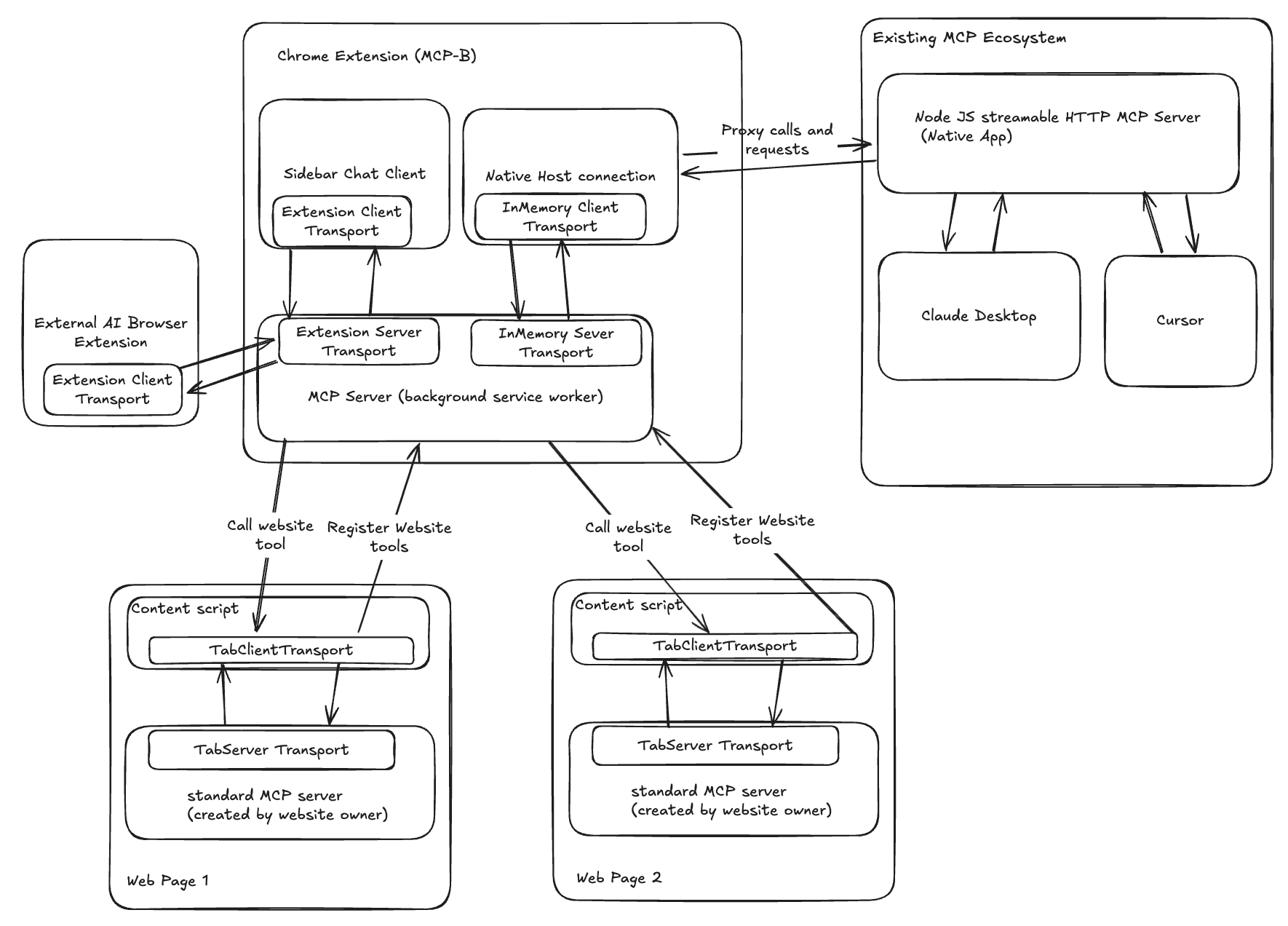
Purpose-built transports enable AI communication across browser contexts: TabServerTransport for cross-tab coordination, IframeTransport for embedded applications, and ExtensionServerTransport for Chrome extensions. Each transport handles security, origin validation, and message routing automatically.
3. Desktop Integration: MCP Protocol Bridge
The MCP-B browser extension translates between WebMCP's browser-native format and Anthropic's Model Context Protocol. This enables Claude Desktop, Claude Code, and any MCP-compatible client to invoke your website's tools as if they were local servers—no backend deployment required.
62+
Extension APIs
6+
NPM Packages
100%
Open Source
Standards First
Implements WebMCP (W3C Web Model Context API) developed by the Web Machine Learning Community Group, with bridge to Anthropic's Model Context Protocol
Zero Configuration
Tools inherit browser sessions automatically—no OAuth flows, no API keys, no credential management. Add AI capabilities with ~50 lines of code
Production Grade
Complete TypeScript SDK with 6+ npm packages, 62+ Chrome Extension API wrappers, and comprehensive schema validation via Zod
Human in the Loop
Browser remains the primary interface where users monitor every agent action in real-time with transparent audit trails and explicit consent
Ecosystem
Comprehensive NPM
Package Ecosystem
MCP-B provides a complete suite of npm packages for every use case—from React hooks to Chrome extension APIs. Each package is TypeScript-native with comprehensive documentation and examples.
Core Packages
Use Cases
What You Can Build
with MCP-B
AI Copilots in Web Apps →
Integrate Assistant-UI or AG-UI with your React app and expose application-specific tools for intelligent assistance.
Browser Automation →
Build Chrome extensions that AI agents can control, enabling sophisticated browser automation through function calls.
Desktop AI Integration →
Connect your web tools to Claude Desktop and Claude Code through the MCP-B extension's native host bridge.
Multi-Tab Communication →
Coordinate AI workflows across multiple browser tabs with TabServerTransport for complex orchestration.
Resources
Explore the Ecosystem
Dive deeper into MCP-B with our comprehensive resources, from technical specifications to working examples
Give your website an MCP interface
Install the Chrome extension to test locally, or jump into the demo app to watch assistants call tools through MCP-B.